Lawrence Ekstrom
Deception PointLawrence Ekstrom is NASA’s administrator, a formidable institutional advocate whose stewardship of the Milne Ice Shelf discovery turns into a crisis of truth and accountability. He helps bring the meteorite before the world as evidence of extraterrestrial life, but behind that public triumph lies a staged account of how it was found. His arc is defined by the gap between his devotion to NASA and the deception he accepts in its name: he conceals a scientist’s death, participates in a politically urgent PODS lie, then finally tells Zach Herney what happened and orders the rock returned to the ocean.
Identity and First Encounter
Rachel Sexton first recognizes Ekstrom at the NASA habisphere on Ellesmere Island: a huge man in a black fleece pullover, emerging from the dome into the snow. His imposing appearance is matched by a reputation for attacking anyone who obstructs his ambitions. Yet his authority is not merely personal. He sees himself as responsible for NASA’s scientists and engineers at a moment when the agency, already under political criticism, is poised to claim a historic achievement.
His first meeting with Rachel establishes the conflict that follows. He tells her that she is present because Herney ordered it, and makes clear that he resents her involvement. Rachel represents the National Reconnaissance Office, whose director Ekstrom believes has disparaged NASA personnel, and she is the daughter of Sedgewick Sexton, a prominent critic intent on destroying the agency. Ekstrom fears that NASA’s moment of recognition will be diluted by the presence of civilian scientists and the daughter of its political opponent. Rachel answers that she, too, is acting under presidential orders and did not come for publicity. Their exchange makes her both an investigator and, in Ekstrom’s eyes, a political complication.
Ekstrom nevertheless briefs her on the discovery. The Earth Observation System uses a constellation of five NASA satellites to examine the planet, while PODS detects density anomalies in polar ice. Two weeks before Rachel’s arrival, PODS identified an unusually hard, roughly ten-foot-wide mass about two hundred feet below the surface of the ice shelf. Ekstrom presents that anomaly as the beginning of the discovery story, a technical result that will soon become a public spectacle.
The Discovery and Its Public Face
During the extraction, Ekstrom arrives at the hole to watch with Rachel, Michael Tolland, and Corky Marlinson as the steel cables rise and the leader chains appear. The crowd’s anticipation gives way to celebration when the charred meteorite emerges: Rachel understands it as an object from another world, apparently carrying proof that humanity is not alone. NASA’s administrator is swept into the moment, congratulating his staff and sharing the crowd’s joy. The scene shows the sincere emotional force of the discovery as well as Ekstrom’s investment in the people whose work has brought it within reach.
He also recognizes the danger surrounding the extraction. Norah Mangor immediately places SHABA pylons around the open shaft, whose smooth ice walls would make escape impossible for anyone who fell in. Ekstrom shakes her hand and praises her work, promising that she will receive public credit. His approval is pointedly practical: the discovery depends on a large, coordinated team, and he acknowledges the scientist whose careful work has helped make the operation succeed.
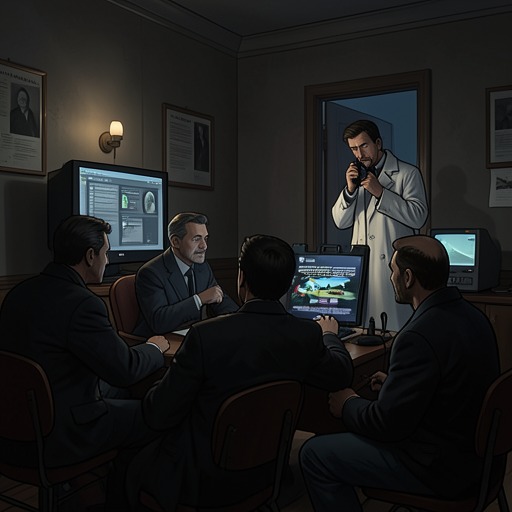
That success is also a communications event, and Ekstrom is uneasy about its political staging. As Herney prepares to announce the discovery, Ekstrom sits with senior NASA officials and scientists in the habisphere’s press area, watching the President’s address on a monitor. The meteorite, NASA insignia, and American flag form a carefully arranged backdrop for the broadcast. Ekstrom privately sees the presentation as an effort to package a scientific discovery for mass consumption, and resents the transformation of NASA’s achievement into a political sideshow. Even so, he remains in place to join the announcement and represent the agency.
Pressure, Concealment, and Complicity
When the scientists discover that the meteorite shaft contains a three-percent saltwater mix and plankton, Ekstrom hears evidence that conflicts with the claim that the meteorite was sealed in pristine freshwater ice. He reacts with anger: the PODS scans had shown no fissures, so the result appears impossible under NASA’s account. The discrepancy threatens not only the scientific interpretation but also the confidence on which the public presentation depends.
A separate crisis exposes Ekstrom’s readiness to control information. After a young technician reports that Wailee Ming has died in an accident, Ekstrom asks who knows and learns that only two workers are aware. He orders them to stow Ming’s body and say nothing, describing the death as tragic while insisting that it is not the time to deal with it publicly. The choice turns an accident into a concealed institutional liability and places NASA’s reputation ahead of immediate disclosure.
Ekstrom’s treatment of Chris Harper reveals another use of institutional pressure. Harper explains that a damaging PODS software mistake had left the system unable to support NASA’s claims; Ekstrom was furious, sent him home on leave, and in effect fired him. Later, when Ekstrom called with a possible way for Harper to redeem himself, Harper returned and announced a software workaround at a press conference. Harper eventually tells Gabrielle Ashe that Ekstrom forced him to lie. Ekstrom’s management thus extends beyond suppressing bad news: he uses a subordinate’s precarious position to supply a public explanation that the agency needs.
The PODS Lie and Its Unraveling
The account Ekstrom eventually gives Herney is more complicated than the impression that the President and NASA jointly devised the meteorite hoax. In a late-night conversation, Ekstrom admits that NASA had intercepted an emergency radio transmission containing the coordinates of the meteorite, sent by Canadian discoverer Charles Brophy, who died in a storm. NASA already had the coordinates, but PODS was not ready to make the discovery in time to help the agency before the election. With Sedgewick Sexton attacking NASA and Herney’s political position under pressure, Ekstrom decided to present the meteorite as a PODS discovery. Herney reacts with disbelief and anger, insisting that Ekstrom has lied to him.
The later account clarifies that Ekstrom’s culpability is real but not identical to William Pickering’s. Pickering says he did not bring Herney or Ekstrom into the wider deception because both were too idealistic to agree to deceit intended to save the presidency or the space agency. Ekstrom’s own wrongdoing, Pickering says, was persuading the PODS mission supervisor to lie about the anomaly software. Marjorie Tench, frustrated by Herney’s refusal to campaign negatively, conspired with Ekstrom over that lie, hoping a small apparent PODS success might help counter Sexton’s growing support. This distinction does not absolve Ekstrom: he accepted deception and helped sustain it. It does show that the fabricated PODS account arose through overlapping decisions rather than a single all-knowing conspiracy shared equally by NASA and the White House.
Confession and Final Decision
Before Ekstrom confesses, he spends hours alone in the quiet habisphere, unable to sleep. He paces, looks into the extraction pit, and runs his hands over the grooves in the charred rock. Only after this solitary reckoning does he decide to call Herney. The conversation is a reversal of his earlier efforts to manage the crisis: rather than contain the secret, he gives the President the account that implicates NASA and himself. Herney’s stunned response makes the confession’s political cost unmistakable.
Ekstrom’s decision also revises his public role. At first he resents the political spectacle around the meteorite but intends to stay another day, oversee its transportation to Washington, and take part in further press conferences. By the time the deception is exposed, he has told Herney what he knows. In the epilogue, aboard the NASA transport jet over the Atlantic, he takes one last look at the rock in the cargo hold and orders the pilot to release it. The meteorite falls into the sea and disappears beneath the waves. The act reverses the extraction that had made it NASA’s triumphant exhibit: the object is returned to the water, and the institutional story built around it is allowed to end. Ekstrom’s final action does not undo his concealments, but it gives his trajectory a concrete conclusion—he abandons the symbol his agency tried to claim.